Showing posts with label Jesus Christ. Show all posts

Thursday, December 24, 2015

The Person of Every Year


TIME magazine recently announced its annual “Person of the Year,” German Chancellor Angela Merkel. The European head of state was selected over seven other final candidates, but for many of us, we’re poised to celebrate the One who could rightly be called “The Person of Every Year.”

We would be hard-pressed to identify anyone that’s ever walked the earth who has had greater impact than Jesus Christ, whose birth we celebrate each Christmas. For those of us who identify ourselves as followers of Christ, or “Christians,” He is our leader, teacher, example, inspiration, and guide. The Bible describes Jesus as Savior, Lord, the Good Shepherd, the True Vine, the Great Physician, and many other names. Perhaps I’ve left out one of your favorites.

But even for those who don’t profess faith in Christ, even those who vehemently reject Him and His claims to be the Son of God, God incarnate, Jesus’ influence in all of our lives remains unmistakable.

Consider: From time to time the secular media refer to someone who willingly volunteers to help a stranger, even at personal peril, as a “good Samaritan.” In Luke 10:25-37, Jesus told the parable of the good Samaritan to illustrate what He meant when commanding His followers to “love your neighbor as yourself.” That phrase itself has become a virtual cliché, regularly used by people of many faiths – and no faith – to assert our obligation to show compassion, mercy and generosity to those less fortunate than ourselves.

The so-called “Golden Rule,” which admonishes us to “do to others what you would have them do to you” (Matthew 7:12), is another of Jesus’ declarations – downright revolutionary for His time. It’s employed with abandon by those who insist on tolerance for all people, except perhaps for those who believe in and follow the One who said it first.

From time to time we’ll hear about a “prodigal son” who returns to a family, a company, even a political party, after a time of “going astray.” Jesus didn’t use the term “prodigal,” but it comes from another of His parables, also referred to as the parable of the lost son or the two sons, found in Luke 15:11-32.

Jesus was unparalleled in His ability to use what writers call “verbal imagery,” communicating a truth through a vivid oral account. A picture on which to hang a principle. Perhaps this is why so many people remember His stories, even if they don’t understand or dismiss His theology.

Sometimes we hear people being described disparagingly as thinking too much of themselves – “she must think she walks on water.” Jesus did this literally, as recounted in Matthew 14:22-33. And more than one business executive has declared, “I sweat blood to get that account,” a phenomenon Jesus experienced the night before His crucifixion: And being in anguish, he prayed more earnestly, and his sweat was like drops of blood falling to the ground” (Luke 22:44).

Of course, Jesus’ uniqueness goes far beyond the words He spoke and His activities on earth. He is the only leader of any religion or belief system reported to have died and then be resurrected. Mohammad, Buddha, Moses, Confucius and others don’t and can’t make that claim.

He boldly declared, “I am the way, the truth and the life. No one comes to the Father (God) except through me” (John 14:6), and also stated, “I have come that they may have life, and have it to the full” (John 10:10). As C.S. Lewis stated, making such statements would mean Jesus either was a liar, a lunatic, or who He said He was – God in the flesh.

And to those who would accept His gift of forgiveness for their sins, possible only by His atoning death on the cross, Jesus made this promise: "In My Father's house are many dwelling places; if it were not so, I would have told you; for I go to prepare a place for you. If I go and prepare a place for you, I will come again and receive you to Myself, that where I am, there you may be also” (John 14:2-3).

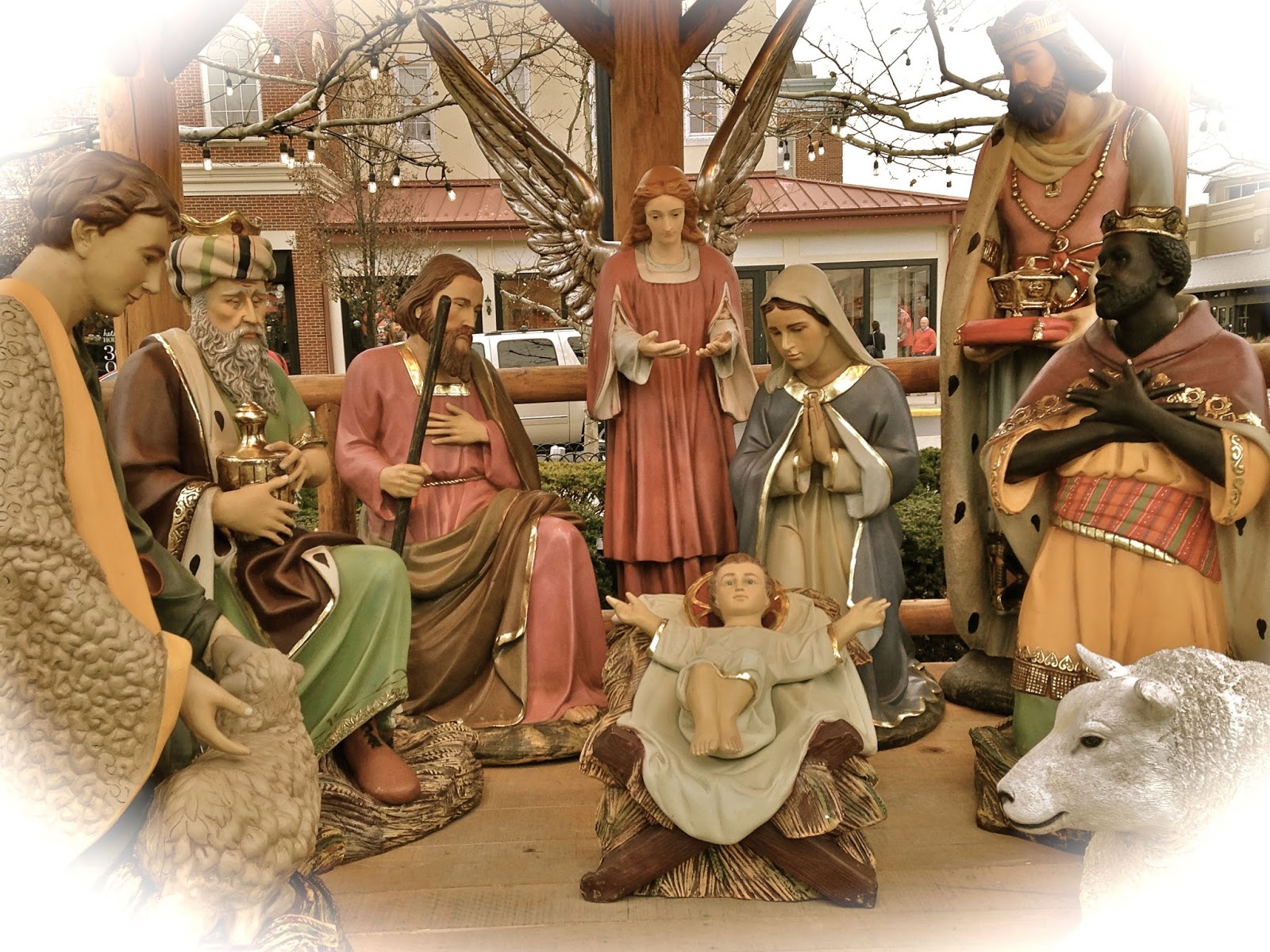
So as we gather this Christmas with family, friends and loved ones, along with the familiar traditions we have adopted through the years, let’s not stop at reflecting on the pastoral scene of a young mother and father, and a baby in a crude feeding trough – hardly fitting accommodations for the One who would become known as the King of Kings and Lord of Lords.

Let’s remember that Jesus Christ truly was – and is – like no other. He’s not the person of the year; for many of us, He’s the person of every year.

Thursday, April 2, 2015

The Holiday Some People Love to Hate


As holidays go, it seems Easter occupies one of the bottom rungs on the marketing ladder. Sure, it has Easter bunnies, jellybeans and candy rabbits, but it definitely lacks the hype of Christmas, or even Thanksgiving.

Christmas has Santa Claus, reindeer, elves, greeting cards, wrapping paper, trees and tinsel, carols, TV specials, and a selling machine that now begins around the middle of September. Thanksgiving has turkey and dressing, pilgrims, pumpkin pie, parades, stomach-busting feasts, and football games.

By contrast, about all Easter really has is…Jesus Christ. And that’s as it should be.

Symbols that surround Easter – like three crosses on Calvary and an empty tomb – aren’t the stuff that make Madison Avenue ad agencies jump for joy, but for followers of Jesus they are indispensable elements of their faith. Without the cross and the vacated tomb representing the resurrected Christ, there would be no cause for either Christmas or Thanksgiving. At least not in a spiritual sense.

And maybe that’s why Easter will never rise to the top of the all-time holiday hits list.

Because there’s something about a cross, and a tomb that’s empty, and a resurrected Lord who declares, “I am the way, the truth and the life. No one comes to the Father except through me” (John 14:6).

Because when so many in the world argue, “Well, if there is a God, I believe there are many ways to God,” Jesus simply replies, “That’s not so.” Instead, He affirms, “I have come that they may have life, and have it to the full” (John 10:10).

Because God says we need not fear death – with only one condition: Jesus. “For God so loved the world that he gave his one and only Son, that whoever believes in him shall not perish but have eternal life. For God did not send his Son into the world to condemn the world, but to save the world through him. Whoever believes in him is not condemned, but whoever does not believe stands condemned already, because he has not believed in the name of God’s one and only Son” (John 3:16-18).

My last post was about names and the power of names, ones that can evoke strong mental and emotional responses. The Bible asserts there is one name that defies comparison: “Therefore God exalted him (Jesus) to the highest place and gave him the name that is above every name” (Philippians 2:9).

What is the impact of this name, Jesus? The passage continues, “that at the name of Jesus every knee will bow, in heaven and on earth and under the earth, and every tongue confess that Jesus Christ is Lord, to the glory of God the Father” (Philippians 2:10-11).

To this some might state, “This doesn’t sound very inclusive!” Others might protest, “Where is the tolerance in that?”

The “tolerance” is in Jesus going to the cross, not for any wrong He had done, but for all of the wrongs – the sins – others had done. “But God demonstrates his own love for us in this: While we were still sinners, Christ died for us” (Romans 5:8). He literally hated the sin but loved the sinners, dying on our behalf.

And then, He offered not only forgiveness but also a transforming new life. “We were therefore buried with him in baptism into death in order that, just as Christ was raised from the dead through the glory of the Father, we too may live a new life” (Romans 6:4).

So I’m glad Easter doesn’t rank with Christmas or even Thanksgiving in terms of commercial holidays. Because it’s about a gift, a reason for celebration that is priceless beyond anything this world could ever offer. Something that, sadly, some people so resent that they hate the day for what it means.

Easter commemorates the day when an angel proclaimed to the women who had come to visit the grave of Jesus that “He is not here; he has risen, just as he said” (Matthew 28:6).

And because of this, every man, woman and child who professes the name of Jesus – the entire worldwide body of Christ – can declare, “Hallelujah!”

Thursday, April 17, 2014

Receiving Life – Through Death


Death. We hate thinking about it yet have a morbid fascination with it. Whenever we hear about a major disaster in which lives were lost, we rush to our news media of choice for details. If someone famous dies – an entertainer, athlete, or public figure – we’re quick to ask our friends, “Have you heard…?”

Many of us have indelible memories etched in stone when asked where we were when we heard JFK was assassinated, Elvis and/or Michael Jackson died, when the space shuttle Challenger exploded, or when the horrific events of 9/11 unfolded.

Local newscasts often open with stories about homicides, traffic fatalities and tragic fires. Why? Because people watch. We read obituaries to see if anyone we know has left this life.

At the same time we’re reluctant to contemplate our own mortality. We procrastinate in writing last wills and testaments, and cringe when thinking about making funeral arrangements in advance, as if delaying those steps could hold our own demise at bay.

But as someone has said, death is the great equalizer. It’s truly the one area in which “all men are created equal.” The mortality rate is 100 percent. It’s more certain than taxes – taxes have shelters, write-offs and deductions, but death has no such things.

So this time of year underscores a great biblical paradox: Receiving life through death.

We’re in the midst of Holy Week, highlighted by the traditional Good Friday observance and Easter celebration. Good Friday commemorates the crucifixion and death of Jesus Christ, who claimed to be the Son of God. And Easter marks the most improbable occurrence of all: His resurrection from the dead and subsequent appearance to hundreds of witnesses, spawning a spiritual movement that continues to multiply, transforming countless lives all around the globe.

Easter is easier to “get,” even without the Easter bunny, chocolate eggs and baby chicks. Good Friday, however, is more of a puzzle. I vividly remember attending a somber Good Friday service at my church as a boy. During the proceedings I asked my mother, “If this is the day Jesus was crucified, why do we call it Good Friday? What’s good about it?”

Lacking formal spiritual training, my mom deferred to “the reverend,” who after the service stood at the door shaking hands with departing congregants. I asked him the same question. As I recall he mumbled something but offered little in response. (As you might surmise, it wasn’t a Southern Baptist church.)

I concluded if the minister – a professional religious person – didn’t know the answer, who would? So my question about the basis for “Good” Friday remained unanswered into my college years and beyond. It didn’t dominate my thoughts, but certainly didn’t seem to make sense.

Then, many years later, I learned the answer. Jesus’ physical death on the cross, described by many as the most excruciating form of execution ever devised, was not “good.” But its purpose and ramifications for humanity certainly were.

Mankind had an insurmountable problem then, as it does today: Sin. Literally it means “missing the mark,” where God’s standard of perfection is non-negotiable. In response to this problem, Jesus came not only to teach and serve as an example, but also to provide the solution. Romans 5:8 states, “But God demonstrates his own love for us in this: While we were still sinners, Christ died for us.” To use a theological term, Jesus became the atonement for our sins. Or to use a more common term of the recent past, He took the rap for us.

But this is where it gets really interesting. It’s more than having sins forgiven and gaining the promise of life after death, even though those are wonderful promises in themselves. The Bible teaches followers of Christ also receive life before death. That’s what Jesus was referring to when He told the Pharisee Nicodemus, “I tell you the truth, no one can see the kingdom of God unless he is born again…no one can enter the kingdom of God unless he is born of water and the Spirit. Flesh gives birth to flesh, but the Spirit gives birth to spirit” (John 3:3-8).

I’ll not attempt to delve much deeper. Hundreds of books have been devoted to expositions on this concept of being “born again” and its significance, both for this life and the next. But I believe it’s the linchpin of the Christian faith, perhaps the singular distinctive between it and all other belief systems. Sadly, it’s an understanding many followers of Christ never fully grasp. As a result, instead of experiencing “victory in Jesus,” they feel defeated, struggling constantly to live a life that’s impossible in their own strength.

Two verses helped to hammer home this truth for me about 30 years ago. One states, “I have been crucified with Christ and I no longer live, but Christ lives in me. The life I live in the body, I live by faith in the Son of God, who loved me and gave himself for me” (Galatians 2:20). The other, 2 Corinthians 5:17, says much the same, only in a different way: “Therefore, if anyone is in Christ, he is a new creation; the old has gone, the new has come.”

For many of us, everyday experience says those verses doesn’t make sense. We’re only human, right? Nobody’s perfect. That’s true, of course, but sinful, ungodly behavior need no longer be the “default setting” for those who have received Christ and know Him as Savior and Lord.

One passage sums up this death-to-life perspective: “We were therefore buried with him through baptism into death in order that, just as Christ was raised from the dead through the glory of the Father, we too may live a new life…. In the same way, count yourselves dead to sin but alive to God in Christ Jesus… You have been set free from sin and have become slaves to righteousness” (Romans 6:4-18).

If you profess to know and follow Christ, but this has not been your experience, don’t take my word for it. What I think doesn’t matter. What matters is what God thinks. So I would strongly encourage you to read and re-read Romans 5-8 and ask God to enable you to understand its meaning in a practical, everyday sense. If you do, this Easter might be one you will never forget.

Monday, December 24, 2012

Uninvited . . . to Your Own Birthday Party?


Can you imagine someone telling you about plans to stage a huge party for your birthday, and then informing you, “Oh, uh, by the way, you’re not invited. We really don’t want you there”?

How quickly would your jaw drop? Would you catch it in time before it hit the floor?

Then, before you could even say, “What?!”, the person would reply, “Oh, nothing personal. Well, actually, it is personal. If you were there, you’d make us feel uncomfortable, and it would have to be all about you. We really don’t want that.”

That’s basically what happens across much of America as we celebrate Christmas. The holiday that incorporates the name of Christ in its title will, in many quarters, have little or nothing to do with Jesus. In fact, great effort is often made to ensure He is excluded from consideration.

So what if the holiday is called Christ-mas? Isn’t it really all about exchanging gifts and Santa Claus and eating good food and spending time with family and friends you don’t see the rest of the year?

Why would the birth of a child be such a
turning point in the history of mankind?
It’s not new, but more than ever in our age of political correctness we sponsor "holiday parties" and schools close for "winter break," instead of Christmas parties and Christmas vacation. In many retail stores and restaurants, employees wish us “Happy holiday” instead of “Merry Christmas.” Nativity scenes on public display are regarded as offensive and intolerant.

And of course we hear profound, high-sounding opinions from “sophisticated” thinkers, commentators and columnists, even religious leaders, discussing and debating “what is the real meaning of Christmas?” To me, such rhetoric is as pointless as analyzing the meaning of spaghetti, or the meaning of a bathrobe. The meaning’s so obvious the question shouldn’t merit a response. But if you exclude Christ from Christmas, you certainly do need to formulate some other explanation for the celebration.

Now if someone asked why we celebrate Christmas on Dec. 25, I’d agree that’s a worthwhile question. No one knows for certain the date Jesus was born. It likely wasn’t Dec. 25. Maybe it was March 17, October 21, or perhaps July 4. Who knows? And what difference does that really make?

The point is that we do celebrate the birth of Christ, aware that had it not been for His life, His death on the cross, His burial and His resurrection, there would be no need to commemorate His birth. Without each of those events, Jesus would be just another forgotten individual born to Jewish parents in the ancient Middle East.

But as John 1:14 informs us, “The Word became flesh and made his dwelling among us. We have seen his glory, the glory of the One and Only, who came from the Father, full of grace and truth.”

God willingly chose to come and live with us, experiencing life as a human being – its joys, its frustrations, its pain, temptations and sorrows. Whenever we want to say, “God, You just don’t understand,” He replies, “Oh, yes I do. I’ve been there and done that.”

He didn’t stay as “little baby Jesus,” but became a man, healing the sick, giving sight to the blind, raising the dead, giving hope to the hopeless, and dying for sins He didn’t commit – so that we could receive forgiveness we don’t deserve. That, I’m convinced, is the real meaning of Christmas.

So as you gather with your loved ones to celebrate Christmas, enjoy the gifts and the food, the banter and the hugs. But please, let Jesus – the Christ of Christmas – be a welcomed guest at His own party.

Tuesday, April 3, 2012

One Life for Another

What would it take for you to give up your life for someone else?
If you’re a parent, you probably would do anything necessary to save the life of a child, even at the risk of your own. A husband or wife might also perform a heroic deed if their spouse were in dire straits.

We have heard stories of soldiers undertaking extraordinary steps of courage to protect or save fallen comrades. Police officers and firefighters frequently are called to put their lives on the line for the sake of others.

But what would it take for you to offer your life on behalf of a stranger?

Occasionally we hear a news account of a individual putting their own life in harm’s way to assist someone they’ve never met – perhaps a person drowning, in a car accident, or similar calamity. But more often we hear about people choosing to stand passively by, watching while a person’s life is in jeopardy, perhaps being beaten or attacked. “Why get involved? It’s none of my business.”

That by far is the more common course.

Perhaps this is one reason Jesus said, “Greater love has no one than this, that he lay down his life for his friends” (John 15:13). Self-sacrifice is not the natural order of things. Rather, we ask, “What’s in it for me?” and if the answer is not enough, we defer.

But that’s not what Jesus did. His great love, far beyond anything we can comprehend, motivated Him to carry out the greatest act of self-sacrifice ever recorded . As the apostle Paul wrote, “But God demonstrates his own love for us in this: While we were still sinners, Christ died for us” (Romans 5:8).

Jesus’ death on the cross was not because we deserved it, as if we were worthy of His atonement. He did it out of love, offering His mercy and grace. By definition, mercy means not receiving what we do deserve, and grace means receiving what we do not deserve.

Thankfully, as we will observe this Friday, He gave His life for each of us, rag-tag sinners and self-absorbed hypocrites, so that we might receive forgiveness, new life, and the promise of life after death.

If it were not for what we call Good Friday, there would have been no Easter. And without Easter, there would be no cause for celebrating Christmas.

But this weekend we do mark both Good Friday and Easter, all because Jesus chose to give His life for someone else – for you and for me. As 2 Corinthians 5:21 tells us, “God made him who had no sin to be sin for us, so that in him we might become the righteousness of God.”

Happy Easter!

Thursday, March 8, 2012

Would You Withhold the Cure?


Suppose a close friend was suffering from cancer and you learned about a newly discovered, 100-percent cure for the disease, but chose not to tell the friend about it?

Or suppose you were visiting a remote Third World village whose inhabitants were dying of starvation and you knew of a plentiful source for free food within easy walking distance, but you decided not to let them know?

Suppose you had loved ones or dear friends that had been unemployed for many months and you heard about immediate job opportunities that would fit them perfectly, but you refused to inform them?

Or suppose someone was drowning in a lake and you were holding a life preserver, but elected not to throw it?

You wouldn’t do any of those things – but just imagine you did. In each instance, wouldn’t you be considered inhumane, heartless, cruel, even criminal?

Yet when followers of Jesus attempt to share what we believe to be the cure to spiritual cancer, the answer to spiritual impoverishment, starvation and death, we’re often ridiculed. Narrow-minded, bigoted, judgmental and “holier than thou” are just some of the derogatory terms directed toward those who believe that when Jesus said, “I am the way, the truth and the life. No one comes to the Father except through me” (John 14:6), He wasn’t kidding – or only referring to a particular group of people.

I’m not an evangelist, but in more than 30 years of walking with Christ I’ve discovered He is the answer to life’s most profound questions: “Why am I here?” “What’s my purpose?” “How do I find meaning?” “Is this all there is?” “What will happen to me when I die?” “How can I make sense of this life?”

If you received great news, wouldn’t you want to share it with others? I feel that way about the Good News of Jesus Christ, both for people who don’t know Him and those who are believers, but haven’t yet experienced the “abundant life” He promises.

What’s our motivation? It should the same as what the apostle John wrote: “We proclaim to you what we have seen and heard, so that you also may have fellowship with us. And our fellowship is with the Father and with his Son, Jesus Christ. We write this to make our joy complete” (1 John 1:3-4).

If that’s narrow-minded, so be it.

Thursday, December 22, 2011

Babies, Change . . . and Christmas!

We wish everyone a blessed, joyous Christmas!

Little babies have a way of changing things in big ways. We’ve been reminded of this firsthand throughout this year with the addition of two delightful little grandsons. They burst upon the scene in a big way in January and February, and we’ll never be the same!

For our family this Christmas will be unlike any other; once again we get to observe the special day through the eyes of a little one.

More than 2,000 years ago, another little baby initiated some really big changes with his inauspicious appearance in a tiny hamlet known as Bethlehem. Even before his arrival, this baby had a resume unlike any other: “For to us a child is born, to us a son is given, and the government will be on his shoulders. And he will be called Wonderful Counselor, Mighty God, Everlasting Father, Prince of Peace” (Isaiah 9:6).

From that humble beginning, the Bible tells us, the baby – named Jesus – grew in wisdom and stature, and in favor with God and men” (Luke 2:52). He is also described as “the Word (that) became flesh and made his dwelling among us” (John 1:14).

Later in the same chapter, John the Baptist declared Him, the Lamb of God, who takes away the sin of the world!” (John 1:29).

Thankfully, Jesus did not remain a baby, even though at this time of year we focus on his birth. His role as Lamb of God, taking upon himself the sin of the world as he hung from a hideous cross, makes His birth worth celebrating.

As we pause to celebrate another Christmas, I hope you’re embracing the truth of Jesus Christ more tightly than ever.

Merry Christmas – and as Tiny Tim said in Charles Dickens’ A Christmas Carol, “God bless us, every one!”

Wednesday, December 14, 2011

The Problem of Impossibility


As we anticipate another Christmas, sometimes it seems we’re pondering the imponderable: A virgin becoming pregnant and having a child. God “becoming flesh,” being born under very ordinary circumstances in an inconspicuous setting. A stable accommodating divinity. This baby growing up, becoming peerless teacher, role model, and ultimately, Savior.

The Christmas story seems so incredible,
no one would have imagined it.
From a human perspective, it would be easy to label all of the above as impossibilities. Certainly agnostics and atheists prefer to relegate the New Testament narrative to “myth” or “fable.” Yet once again, on Dec. 25, countless millions will celebrate the birth of Jesus Christ. Many of them can attest to the life-changing, transformational impact of being followers of Jesus.

No other person’s life has influenced mankind to the magnitude of the carpenter from Nazareth, the one called “the good shepherd,” “the way, the truth and the life,” “the true vine,” “the Lamb of God,” “the light of the world.”

Still, God taking on human form? It seems so…impossible. But then, that’s what God is all about – doing the impossible, existing and working beyond the scope of human comprehension. As the angel responded in Luke 1:37 when Mary asked how she, a virgin, could bear a child: “For nothing is impossible with God.”

Later in the same book, Jesus made a similar declaration: “What is impossible with men is possible with God” (Luke 18:27).

There, in just a handful of words, we find the crux of the dilemma. We are asked, by faith, to believe in the seemingly impossible, trusting in a God unlimited by time, space, or circumstances. Disbelief doesn’t daunt Him; sin doesn’t stalemate Him.

Years ago, “Mission: Impossible” was a popular TV series. More recently, films starring Tom Cruise have carried the same title. But when it comes to carrying out missions impossible, Jesus Christ must rank as the all-time champion.   

Monday, April 18, 2011

It’s Friday…But Sunday’s Coming!

As a boy attending a Good Friday worship service, I turned to my mother and honestly asked, “If this was the day Jesus was crucified, why do we call it ‘Good Friday’?”

That’s still a good question today.

Good Friday gets its goodness through the clarity of hindsight. When events took place that day more than 2,000 years ago, nothing seemed good about it – except to the executioners. It was a dark, depressing, dismal day. As those who had followed Him watched Jesus agonize on a crude wooden cross and die, this meant much more than losing a treasured friend. It meant the death of their cause, the dashing of hopes, the demise of a promising future they had envisioned.

Two days later, however, everything changed. As they learned about the empty tomb, and when Jesus appeared to them very much alive, the pain and grief of the preceding Friday was dispelled.

There are those who argue the resurrection is fable, a myth. The apostle Paul countered by observing: “If Christ has not been raised, our preaching is useless and so is your faith…. But Christ has indeed been raised from the dead…so in Christ all will be made alive” (1 Corinthians 15:14-22).

Evidence is irrefutable – except for those who simply refuse to believe. Hundreds of people personally witnessed the risen Christ just days after the crucifixion. Secular historians confirmed the resurrection account. The presence of million upon millions of followers of Jesus worldwide today – even in lands where such faith is forbidden – attests to this fact. And there are countless “new creations in Christ” (2 Corinthians 5:17), individuals whose transformed lives defy other explanation.

Still, why is it “Good” Friday? Why celebrate such a hideous execution? The Bible gives several reasons:

Forgiveness. “But God demonstrates his own love for us in this: While we were still sinners, Christ died for us. Since we have now been justified by his blood, how much more shall we be saved from God’s wrath through him!” (Romans 5:8-9). “God made him who had no sin to be sin for us, so that in him we might become the righteousness of God” (2 Corinthians 5:21).

Life after death. “For God so loved the world that he gave his one and only Son, that whoever believes in him shall not perish but have eternal life” (John 3:16).

New life for today. “We were buried with him through baptism into death in order that, just as Christ was raised from the dead through the glory of the Father, we too may live a new life…. In the same way, count yourselves dead to sin but alive to God in Christ Jesus” (Romans 6:4,11).

Is death ever a good thing, even for God? No. But when the Word that became flesh willingly went to the cross, to pay the penalty for the sins of mankind once and for all, death was defeated. "Where, O death, is your victory? Where, O death, is your sting?" (1 Corinthians 15:51).

The atoning sacrifice was achieved. Our debt was paid in full. As a friend of mine liked to say, “Jesus took the rap for us.” And for that, it truly is Good Friday. It could never be better.

Wednesday, December 22, 2010

Why All the Fuss About Christmas?

Almost all of us enjoy the common Christmas image of the babe lying in repose inside a stable, surrounded by loving mother and father, barnyard animals, shepherds, angels, maybe the three wise men – the Magi. But billions of children have been born through the ages, most of them cute and cuddly. Have you ever wondered, what’s the big deal about Christmas?

The “big deal,” of course, is first, “the Word became flesh and made his dwelling among us” (John 1:14). If we are to believe the biblical account, God became “incarnate” – took on human form, leaving the realm of heavenly perfection to immerse Himself in the world of flawed, sinful humanity.

Second, this baby – Jesus, the Son of God, whom Hebrews 1:3 describes as “…the radiance of God’s glory and the exact representation of his being…” – grew not only to become a great teacher and example, but ultimately the Savior of mankind, willfully dying for our sins on a cruel, torturous cross. “But God demonstrates his own love for us in this: While we were still sinners, Christ died for us” (Romans 5:8).

And there’s a third reason: The first coming of Jesus more than 2,000 years ago was just the prelude, a promise of His second coming. He told His disciples, “…at that time they will see the Son of Man coming in a cloud with power and great glory. When these things begin to take place, stand up and lift up your heads, because your redemption is drawing near” (Luke 21:27-28).

So Christmas morning, as we sit near lighted trees and open festively wrapped gifts, we should pause to reflect on the real meaning of Christmas: not Santa Claus, not gifts, but Christ.

We celebrate because Jesus came – but we also celebrate because we know He’s coming again!

Wednesday, November 10, 2010

Deleted from Expletives

All religions have acknowledged leaders: Islam has Mohammed; Buddhism has Buddha, Hinduism has Vishnu and many others; Confucianism has Confucius; Judaism has Moses; and Christianity, of course, has Jesus Christ.

But have you ever noticed of all those names, only one is used by some as profanity? When was the last time, for instance, you heard someone say, “Expletive Confucius”? Or “Blankety-blank Buddha”? Muslims so revere Mohammed, people that write or speak derogatorily about the prophet are threatened with death.

But Jesus Christ? That’s different. Often in films, sometimes on TV, frequently in books, we hear or read people using His name as an angry epithet or sometimes just part of their everyday vocabulary. I once worked for a man that included “Jesus Christ” in his sentences as casually and unashamedly as most people would say “um” or “you know.”

Why is this? Why is the name adored by countless millions throughout the world, the person declared by the Bible as the Son of God, the only one among religious icons deemed fair game for dragging through the mud?

The greatest war being waged on earth is not political, nor ideological or economic. It’s a spiritual war – a battle of eternal truth versus falsehood and deception. If Jesus actually is “the way, the truth and the life,” as He declared (John 14:6), there is bound to be resistance from those who regard that as too rigid or “intolerant.”

But this is more than a clash of viewpoints and opinions. It’s a fight that’s being directed from what the Scriptures term “the gates of hell.” And if it’s true one day “at the name of Jesus every knee should bow…and every tongue confess that Jesus Christ is Lord” (Philippians 2:10-11), we can expect intense spiritual opposition until then.