Years ago I was on the interstate driving home after meeting
with a friend. Suddenly I heard a loud “boom” and immediately it felt like my
car was traveling on a cobblestone road. Quickly pulling to the roadside, I found
the right rear tire totally flat. More than flat – shredded. (Have you ever had
shredded wheat cereal for breakfast? That’s what the tire looked like.)
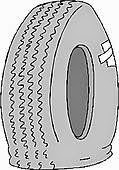 |
| One flat tire is troublesome enough, but two at once? |
After replacing the destroyed tire with the spare tire
“donut” provided by the manufacturer, I started out, expecting to complete my
return trip. But the car began shuddering as much as before. So I again steered
off the road and discovered the right front tire also in shreds. What? Flat
tires are common, but how often do two go flat simultaneously? I hadn’t seen
anything in the road, but something large and very sharp must have cut both
tires severely.
Nothing like turning a smooth, carefree ride back to the
office into chaos. It gave whole new meaning to the term, “tire-less worker.”
Since vehicles don’t come with two donuts, I called a
wrecker service to haul my car to the next exit and find someplace to replace
both tires. My unexpected travel dilemma required not one solution, but two.
I was reminded of this experience recently by my friend,
Randy Nabors. In his own blog post entitled, “Sometimes A Car Has More Than One
Flat Tire,” he comments on circumstances surrounding the shooting and
subsequent protests in Ferguson, Mo. I’ll not get into what Randy has to say,
but it’s insightful. If you’d like to read it, here’s the link: http://randysrag.blogspot.com/2014/08/sometimes-car-has-more-than-one-flat.html
Applying this observation in a broader sense, life’s
problems often have multiple facets that can’t be resolved in one easy step. Poverty
is one example. Some people insist the solution is simply raising the minimum
wage. Increase hourly pay a few dollars, problem solved. Nice theory.
This certainly would provide relief, at least for some, but
issues surrounding the poor – and poverty in general – are numerous, complex,
and often multi-generational. Deeply rooted problems stemming from poor
education, declining parental influence, lack of preparation and training for
jobs, even a lack of positive role models, individuals who’ve risen above impoverished circumstances to provide hope and inspiration for others. Simply boosting
hourly pay rates could help, but as a long-range answer it would be
like applying a Band-Aid to a cancerous growth.
The “sometimes there’s more than one flat tire” principle applies
to many pressing issues facing our society and the world today: Health care,
escalating violence, energy concerns, war, disease, equal opportunity, economic disparity,
bigotry, and others. In the home, resolving marital strife, the challenge of
raising and guiding children to become productive adults, addressing financial
problems, and other problems also can often seem like incurring multiple flat
tires on a car at the same time.
So what should we do, individually and as a people? Shrug our
shoulders and declare the problems are too many, too complicated, so everyone should
just look out for themselves? This seems to be the attitude of some, but we
know it’s not the right response. And while the easy, quick fix often can’t
eradicate deeply rooted problems, any attempt to provide help is better than no
efforts to offer assistance.
James 4:17 states, “Therefore,
to one who knows the right thing to do and does not do it, to him it is sin.” So we have a
responsibility to do what we can. To recognize a problem, but choose to do
nothing when we have the capacity to help in some way, is sinful and abhorrent
to God, according to the Bible.
At the same time, isolated
attempts to address problems, without the concerted efforts and contributions of
other able-bodied and resourced people, usually amount to the proverbial “drop
in the bucket.” For persistent problems defying the quick-fix, the book
of James offers more advice: “If any of
you lacks wisdom, he should ask God, who gives generously to all without
finding fault, and it will be given to him” (James 1:5).


