Showing posts with label minimum wage. Show all posts

Monday, September 8, 2014

When You Have Two Flat Tires, Not One


Years ago I was on the interstate driving home after meeting with a friend. Suddenly I heard a loud “boom” and immediately it felt like my car was traveling on a cobblestone road. Quickly pulling to the roadside, I found the right rear tire totally flat. More than flat – shredded. (Have you ever had shredded wheat cereal for breakfast? That’s what the tire looked like.)
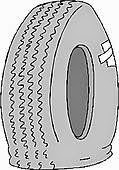
One flat tire is troublesome
enough, but two at once?
After replacing the destroyed tire with the spare tire “donut” provided by the manufacturer, I started out, expecting to complete my return trip. But the car began shuddering as much as before. So I again steered off the road and discovered the right front tire also in shreds. What? Flat tires are common, but how often do two go flat simultaneously? I hadn’t seen anything in the road, but something large and very sharp must have cut both tires severely.

Nothing like turning a smooth, carefree ride back to the office into chaos. It gave whole new meaning to the term, “tire-less worker.”

Since vehicles don’t come with two donuts, I called a wrecker service to haul my car to the next exit and find someplace to replace both tires. My unexpected travel dilemma required not one solution, but two.

I was reminded of this experience recently by my friend, Randy Nabors. In his own blog post entitled, “Sometimes A Car Has More Than One Flat Tire,” he comments on circumstances surrounding the shooting and subsequent protests in Ferguson, Mo. I’ll not get into what Randy has to say, but it’s insightful. If you’d like to read it, here’s the link: http://randysrag.blogspot.com/2014/08/sometimes-car-has-more-than-one-flat.html

Applying this observation in a broader sense, life’s problems often have multiple facets that can’t be resolved in one easy step. Poverty is one example. Some people insist the solution is simply raising the minimum wage. Increase hourly pay a few dollars, problem solved. Nice theory.

This certainly would provide relief, at least for some, but issues surrounding the poor – and poverty in general – are numerous, complex, and often multi-generational. Deeply rooted problems stemming from poor education, declining parental influence, lack of preparation and training for jobs, even a lack of positive role models, individuals who’ve risen above impoverished circumstances to provide hope and inspiration for others. Simply boosting hourly pay rates could help, but as a long-range answer it would be like applying a Band-Aid to a cancerous growth.

The “sometimes there’s more than one flat tire” principle applies to many pressing issues facing our society and the world today: Health care, escalating violence, energy concerns, war, disease, equal opportunity, economic disparity, bigotry, and others. In the home, resolving marital strife, the challenge of raising and guiding children to become productive adults, addressing financial problems, and other problems also can often seem like incurring multiple flat tires on a car at the same time.

So what should we do, individually and as a people? Shrug our shoulders and declare the problems are too many, too complicated, so everyone should just look out for themselves? This seems to be the attitude of some, but we know it’s not the right response. And while the easy, quick fix often can’t eradicate deeply rooted problems, any attempt to provide help is better than no efforts to offer assistance.

James 4:17 states, Therefore, to one who knows the right thing to do and does not do it, to him it is sin.” So we have a responsibility to do what we can. To recognize a problem, but choose to do nothing when we have the capacity to help in some way, is sinful and abhorrent to God, according to the Bible.

At the same time, isolated attempts to address problems, without the concerted efforts and contributions of other able-bodied and resourced people, usually amount to the proverbial “drop in the bucket.” For persistent problems defying the quick-fix, the book of James offers more advice: “If any of you lacks wisdom, he should ask God, who gives generously to all without finding fault, and it will be given to him” (James 1:5).

Knowledge is good and important. But it requires wisdom to determine how best to sift through the vast storehouse of knowledge available and discern how best to apply it, aiming to solve or at least alleviate problems rather than intensify and prolong them.

Monday, December 30, 2013

To Get Paid More You Have to Be Worth More

The boots on the left are what Gary Highfield wore at the steel shop;
on the right are his first business shoes, which he's re-soled several times.

As each year draws to a close, many people review the past year and consider what changes they’d like to see in the coming year. I’d imagine fast-food workers that protested low wages can be counted among them.

You might recall thousands of employees at McDonald’s and other chains insisting the Federal minimum wage be increased. Some proposed the current minimum of $7.25 be more than doubled to $15 per hour. Working full-time at the current rate, they explained, it’s nearly impossible to pay their bills, much less get ahead in life.

From a pragmatic perspective this makes sense. A person working 40 hours a week, 52 weeks a year at the present rate barely earns $15,000. And that’s before taxes and other deductions. Who can live on that, especially with a family?

If the government mandated the minimum wage be boosted to $15 per hour, that would raise the full-time fast-food worker’s annual pay to more than $31,000. Not bad for flipping burgers and asking customers, “Do you want fries with that?”

While I’m sympathetic toward people struggling to eke out a reasonable standard of living on low incomes, there might be a better approach than waiting and hoping for government or corporate largesse to lift them out of their circumstances.

Consider this: In a newspaper article about the workers’ protest, one man stated he’d been working in the fast-food industry for six years at the $7.25 hourly rate. Six years? Do you suppose he’s being held there at gunpoint? If his compensation is unsatisfactory, why hasn’t he done something during that time to prepare for a better paying and, probably, more fulfilling job?

Let me share some of what I learned from my friend, Gary Highfield, who recounts his life’s journey in When ‘Want To’ Becomes ‘Have To!’ – Breaking the Chains That Are Holding You Back. About 30 years ago, Gary was one of those underpaid hourly workers, performing manual labor for a steel fabricating company. He was making $7 an hour, hardly enough for a family of five to survive, much less thrive.

Desiring a better life for his wife and children, Gary applied for food stamps. His request was denied – he was earning 33 cents a day too much to qualify. Next he approached his boss for a $1 per hour pay increase. At that stage in Gary’s life, $2,000 more per year would have felt like he’d won the lottery. But his boss said no.

Poor Gary, right? Well, not as he tells it. Reflecting on those apparent setbacks, he notes the irony: “The worst thing that ever happened to me was the best thing that ever happened to me.”

Gary holds the shoes and boots that represent
different stages of his life and career, in front
of an office building where he made many sales.
Instead of resigning himself to a life of pinching every penny, or curling up in a fetal position and wallowing in self-pity, Gary took action. Realizing he couldn’t count on either the government or his employer to provide the better life he wanted, Gary stumbled onto an important principle: To get paid more, you have to become worth more.

He embarked on a comprehensive self-improvement program: strengthening interpersonal skills; learning sales and marketing secrets by attending seminars, reading books and listening to tapes; discovering how to dress to make a good impression; even pursuing a job relentlessly until he was hired for no reason other than his persistence.

What was the outcome? Within 18 months he had nearly tripled his income. He became the top salesperson at his company, and within several years was earning seven times what he had been making at the steel shop.

All this was due, in part, to not qualifying for food stamps and not receiving the pay raise he requested. These reversals taught him the difference between depending on someone else and depending on oneself.

Even when friends sounded doubtful, questioning the bold steps he was taking to improve life for himself and his family, and he encountered other obstacles, Gary refused to accept failure as a final verdict. As he says today, “Impossible isn’t possible…until you quit.”

Of course, he didn’t achieve this all by himself. People entered his life at key moments, ranging from a generous clothier to employers willing to give him a chance. Looking back, Gary regards many of these encounters as “divine appointments.” Without question, God was in the midst of his quest for a better life.

In the process he learned an important biblical truth: “Trust in the Lord with all your heart, and do not lean on your own understanding. In all your ways acknowledge Him and He will direct your paths” (Proverbs 3:5-6). God has a purpose for each of us, and if we’re willing to step out in faith, He’ll reveal a plan beyond anything we could have envisioned.

So what about the protesting fast-food workers? For some, maybe there’s no other employment option. For others, however, the first step is realizing that unless they’re aspiring to management positions, McDonald’s probably isn’t a career destination but just a stop along the way. A second step is trying to figure out what they’d really like to do in life and determining how to achieve it.

As Gary would tell any of them, it won’t be easy. But the hard work, perseverance and sacrifice to get there will be worth it. The alternative? As he says, “If you fail to plan, you’re planning to fail.”