Showing posts with label if any of you lacks wisdom. Show all posts

Thursday, March 31, 2022

A Fool’s Day to Fuel the Fool in All of Us

What an amazing thing – having a whole day designated for celebrating fools and foolishness! April Fool’s Day, April 1, marks the start of a new month, and brings with it motivation to pull little pranks on each other, all in the name of “April fool!”


Some experts historically – or hysterically – trace the origins of April Fool’s Day, also known as All Fools Day, as far back at 1582 in France, upon switching from the Julian calendar to the Gregorian calendar. But others say the “holiday” actually began in 1700, when the tradition of playing practical jokes on one another was birthed in jolly old England.

Regardless of when it formally began, one day a year for a little lighthearted foolery seems fine. In reality, however, foolishness and being a fool are no laughing matter. Judging by what some folks say and do, it seems that for them, “fool’s day” is a year-round preoccupation. 


We even have sayings especially devoted to addle-brained people. Essayist and philosopher Henry David Thoreau said, “Any fool can make a rule. And any fool will mind it.” Mark Twain said, “I was young and foolish; now I’m old and foolisher.” Benjamin Franklin observed, “Any fool can criticize, condemn and complain – and most fools do.” More than two centuries have passed since then, but things seem not to have changed much.


We’ve all heard the adage of indefinite origin, “A fool and his money are soon parted.” Humorist Will Rogers offered a somewhat different view: “A fool and his money are soon elected.” That observation, too, seems to have weathered well the passage of time. In fact, thousands of years ago the writer of Proverbs said, “Of what use is money in the hand of a fool, since he has no desire to get wisdom” (Proverbs 17:16). 


The Scriptures have much to say about the perils of fools and foolishness. In the book of Proverbs alone, we find dozens of warnings and admonitions about lacking wisdom and choosing folly instead. For instance, Proverbs 10:14-15 is straight-forward in contrasting the speech of the wise and the foolish:

“Wisdom is found on the lips of the discerning, but a rod is for the back of him who lacks judgment. Wise men store up knowledge, but the mouth of a fool invites ruin.”


Proverbs 15:7 makes a similar observation: “The lips of the wise spread knowledge; not so the hearts of fools.” If you’re in need of wise counsel and sound advice, consider the source!


Remember the adage, “Look before you leap”? Proverbs 14:8 offers a similar caution: “The wisdom of the prudent is to give thought to their ways, but the folly of fools is deception.” We find the same sentiment in Proverbs 15:21, which declares, “Folly delights a man who lacks judgment, but a man of understanding keeps a straight course.”


We’ve probably all encountered people during our lives who would fit the descriptions above. In recognizing the pitfalls of falling under the influence of foolish friends, the image evoked by the following verse is particularly powerful: “Better to meet a bear robbed of her cubs than a fool in his folly” (Proverbs 17:12). Gulp!


Dozens of other passages advise us to steer clear of those who seem to revel in their own folly. However, perhaps what matters most is how we can avoid falling into the same trap. Because in our fallen world, foolishness isn’t hard to find. 


I’ve cited the following verses before, but they’re worth pondering again. Proverbs 1:7 declares, “The fear of the Lord is the beginning of knowledge, but fools despise wisdom and instruction.” Maybe one reason we live in such foolish, nonsensical times is that we’ve drifted away from the fear of the Lord.


Another commonly cited verse teaches, “If any of you lacks wisdom, he should ask God, who gives generously to all without finding fault, and it will be given to him” (James 1:5). Similarly, Proverbs 2:6 promises, “For the Lord gives wisdom, and from his mouth come knowledge and understanding.”

So, as another April 1 arrives with its celebration of fools and folly, go ahead – enjoy pulling a harmless prank or two, or allow yourself to play victim to someone else’s trickery. But let the day also serve as a reminder of the dangerous snares of perpetual foolishness. As Proverbs 28:26 warns, “He who trusts in himself is a fool, but he who walks in wisdom is kept safe.” 

Monday, September 8, 2014

When You Have Two Flat Tires, Not One


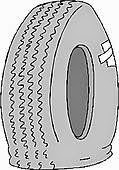
Years ago I was on the interstate driving home after meeting with a friend. Suddenly I heard a loud “boom” and immediately it felt like my car was traveling on a cobblestone road. Quickly pulling to the roadside, I found the right rear tire totally flat. More than flat – shredded. (Have you ever had shredded wheat cereal for breakfast? That’s what the tire looked like.)

One flat tire is troublesome
enough, but two at once?
After replacing the destroyed tire with the spare tire “donut” provided by the manufacturer, I started out, expecting to complete my return trip. But the car began shuddering as much as before. So I again steered off the road and discovered the right front tire also in shreds. What? Flat tires are common, but how often do two go flat simultaneously? I hadn’t seen anything in the road, but something large and very sharp must have cut both tires severely.

Nothing like turning a smooth, carefree ride back to the office into chaos. It gave whole new meaning to the term, “tire-less worker.”

Since vehicles don’t come with two donuts, I called a wrecker service to haul my car to the next exit and find someplace to replace both tires. My unexpected travel dilemma required not one solution, but two.

I was reminded of this experience recently by my friend, Randy Nabors. In his own blog post entitled, “Sometimes A Car Has More Than One Flat Tire,” he comments on circumstances surrounding the shooting and subsequent protests in Ferguson, Mo. I’ll not get into what Randy has to say, but it’s insightful. If you’d like to read it, here’s the link: http://randysrag.blogspot.com/2014/08/sometimes-car-has-more-than-one-flat.html

Applying this observation in a broader sense, life’s problems often have multiple facets that can’t be resolved in one easy step. Poverty is one example. Some people insist the solution is simply raising the minimum wage. Increase hourly pay a few dollars, problem solved. Nice theory.

This certainly would provide relief, at least for some, but issues surrounding the poor – and poverty in general – are numerous, complex, and often multi-generational. Deeply rooted problems stemming from poor education, declining parental influence, lack of preparation and training for jobs, even a lack of positive role models, individuals who’ve risen above impoverished circumstances to provide hope and inspiration for others. Simply boosting hourly pay rates could help, but as a long-range answer it would be like applying a Band-Aid to a cancerous growth.

The “sometimes there’s more than one flat tire” principle applies to many pressing issues facing our society and the world today: Health care, escalating violence, energy concerns, war, disease, equal opportunity, economic disparity, bigotry, and others. In the home, resolving marital strife, the challenge of raising and guiding children to become productive adults, addressing financial problems, and other problems also can often seem like incurring multiple flat tires on a car at the same time.

So what should we do, individually and as a people? Shrug our shoulders and declare the problems are too many, too complicated, so everyone should just look out for themselves? This seems to be the attitude of some, but we know it’s not the right response. And while the easy, quick fix often can’t eradicate deeply rooted problems, any attempt to provide help is better than no efforts to offer assistance.

James 4:17 states, Therefore, to one who knows the right thing to do and does not do it, to him it is sin.” So we have a responsibility to do what we can. To recognize a problem, but choose to do nothing when we have the capacity to help in some way, is sinful and abhorrent to God, according to the Bible.

At the same time, isolated attempts to address problems, without the concerted efforts and contributions of other able-bodied and resourced people, usually amount to the proverbial “drop in the bucket.” For persistent problems defying the quick-fix, the book of James offers more advice: “If any of you lacks wisdom, he should ask God, who gives generously to all without finding fault, and it will be given to him” (James 1:5).

Knowledge is good and important. But it requires wisdom to determine how best to sift through the vast storehouse of knowledge available and discern how best to apply it, aiming to solve or at least alleviate problems rather than intensify and prolong them.

Monday, August 4, 2014

One Thing the Internet Can’t Teach Us


I never cease to marvel over the vast and ever-growing storehouse of knowledge the Internet offers to us. Years ago, when doing research for a book or an article, I’d usually jump in the car and drive to the nearest library. I have nothing against libraries – they’re fun places to visit – but thanks to the Internet I haven’t needed to go to a library for information in several years.

Just about anything we could think can be found on the Internet: biographies, famous quotations, recipes, summaries of books and films, health information, do-it-yourself tips (not that I’d have any interest in those), sports statistics, weather forecasts, phone numbers, map and directions. You name it, it’s there.

My wife and I recently marked our 40th anniversary, so out of curiosity I looked up the year 1974 on the Internet to see what was going on then – it was too long ago to remember! I found out Richard Nixon was in the midst of the Watergate scandal; 24-hour a day radio news coverage was just starting; “Happy Days” was beginning its 11-year TV run; Peter Benchley’s book, Jaws, was published; Barbra Streisand was singing “The Way We Were”; and somebody named Woody Hayes was coaching the Ohio State football team.

We'd all like to be wise as the proverbial owl.
But where and how does the owl get its wisdom?
You can find anything you need to learn online. That is, almost anything. One thing you can’t learn from the Internet is wisdom.

True, you can learn the definition of wisdom. The one I like best is: “the ability or result of an ability to think and act utilizing knowledge, experience, understanding, common sense, and insight.” Another defines wisdom as “the soundness of an action or decision with regard to the application of experience, knowledge, and good judgment.”

We can even find out what other people have said about wisdom. I never thought of the late great rock guitarist and vocalist Jimi Hendrix as a fount of wisdom, but he observed, “Knowledge speaks, but wisdom listens.” Must have come from one of his more elucidating LSD moments.

Author Aldous Huxley asserted, “Experience is not what happens to you; it's what you do with what happens to you.” There’s considerable wisdom in that recognition. Sounds like the voice of experience.

Philosopher Socrates once stated, “The only true wisdom is in knowing you know nothing.” I wouldn’t go that far, but it’s occurred to me that the older you get and the more you think you know, the more you discover you don’t know yet.

Revered Chinese philosopher Confucius pointed to the reality of wisdom’s attainment when he said, “By three methods we may learn wisdom: First, by reflection, which is noblest; second, by imitation, which is easiest; and third by experience, which is the bitterest.”

President Calvin Coolidge gave a similar view when he commented, “Knowledge comes, but wisdom lingers. It may not be difficult to store up in the mind a vast quantity of facts within a comparatively short time, but the ability to form judgments requires the severe discipline of hard work and the tempering heat of experience and maturity.”

The Internet truly is a bottomless well for information and knowledge, and we can learn a lot about wisdom, but you’ll never gain wisdom solely through mental exercise. It is, as Huxley commented, what you do with what you get. And there’s no substitute for time and experience.

But there’s one more source of wisdom we too often disregard entirely. The Scriptures tell us where to find it: “The fear of the Lord is the beginning of knowledge, but fools despise wisdom and instruction” (Proverbs 1:7).

James 1:5 says wisdom can be ours just for the asking: “If any of you lacks wisdom, he should ask God, who gives generously to all without finding fault, and it will be given to him.” But there’s a caveat to such a request, as the next verse points out. “But when he asks, he must believe and not doubt, because he who doubts is like a wave of the sea, blown and tossed by the wind” (James 1:6).

Later in the book it states, “The wisdom that comes from heaven is first of all pure; then peace-loving, considerate, submissive, full of mercy and good fruit, impartial and sincere” (James 3:17). That sounds like something worth having.

True, much of wisdom comes through the everyday grind of life’s hard knocks. As someone as said, the way to get wisdom is through experience, and the way to gain good experience is by making mistakes and having bad experiences. But if we can tap into the wisdom of God, maybe we can avoid having to endure some of those bad experiences brought about by foolish mistakes. I’ve already made more than my share of those!

Monday, May 12, 2014

Do We Have a Wisdom Deficit?


The amount of knowledge available to mankind is growing exponentially, in part because of computer technology, along with our extensive use of tablets and smartphones. If you need information on virtually any topic, it’s only clicks away.

We no longer need to trudge into the library and hunt through stacks of books to find one with the exact information we need. Select the search engine you prefer, type in the appropriate words and “voila!” – there it is. And you didn’t have to drive anywhere or even get up from your chair.

In this Wikipedia Commons photo,
Auguste Rodin's "The Thinker"
seems to be contemplating
where to find wisdom.
And when was the last time you heard of anyone buying a real set of encyclopedias? We used to spend hundreds of dollars for a couple dozen volumes only to discover within a year they were already out of date. Before we knew it, the Book of Knowledge didn’t know as much as we thought it did. Now we’ve got Wikipedia and other online sources being updated constantly.

The thing about knowledge and information, however, is they’re not the same as wisdom. Yes, wisdom requires knowledge, but it’s more than that. It’s also a blend of experience, insight, and as I recently heard someone state, “just judgment.” Wisdom is the quality in a person you look for when making a critical decision – someone you can approach, lay out the circumstances and pertinent information, and then solicit their viewpoint.

My father used to say, “Some people are so smart they’re stupid.” In other words, they had intellect and a storehouse of knowledge, but didn’t know how to apply it in useful ways. They lacked wisdom. Other people might not have impressive college degrees, but they have “horse sense” –a way of slicing through extraneous details and getting to the heart of the matter to find a workable solution to a dilemma.

Today as a people, a society, even a global community, we’re beset with problems that defy resolution: Poverty, escalating violence, looming threats of terrorism, global hunger, wars, fractured families, racism and bigotry, among others. Politicians can’t seem to move beyond their partisan agendas to find answers in the best interests of all.

On a personal level, we wrestle with our own unique issues: the seemingly endless pursuit of happiness, seeking direction for everyday living, restoring troubled relationships, feelings of despair and hopelessness, searching for meaning and purpose.

These issues have confronted mankind through the centuries, but it seems we’re no closer to finding answers today, despite the amassed facts and information at our disposal. Could it be the problem is not knowledge, but a deficit of wisdom?

Where do we get this wisdom? I don’t recall seeing it on sale at Wal-Mart, Publix or Target, and I’ve never heard of a university or college offering Wisdom 101, let alone Wisdom 452. We can acquire a measure of wisdom simply through the process of living, learning from experiences good and bad, and striving to act accordingly. But there’s a time-honored source we seem to have forgotten in our increasingly secularized society – the Bible.

James 1:5 states, “If any of you lacks wisdom, he should ask God, who gives generously to all without finding fault, and it will be given to him.” But in large measure we’ve collectively decided we don’t need God – somehow we think we’re doing fine without Him. As a result, “You want something but don’t get it. You kill and covet, but you cannot have what you want. You quarrel and fight. You do not have, because you do not ask God” (James 4:2).

The Bible’s “book of wisdom” starts by proclaiming, “The fear of the Lord is the beginning of knowledge, but fools despise wisdom and instruction” (Proverbs 1:7). In refusing to honor and worship God, choosing to worship the creation rather than the Creator – as the apostle Paul writes in Romans 1:25 – we deprive ourselves of the primary source of wisdom.

Proverbs 3:19 declares, “By wisdom the Lord laid the earth’s foundations, by understanding he set the heavens in place.” We’re rightfully concerned with the state of our physical world, wanting to protect this earth God fashioned and entrusted to our care, but we refuse to consult Him on what we should do. Guess we’ve decided we know better than He does.

But even at the “down home” level, we desperately need wisdom for sailing the often murky waters of marriage; raising strong, stable children in an age of so many contradictory messages; handling finances in an uncertain economy; finding peace in the midst of great pain and unrest. If we’re willing to look, God has provided how-to’s in the Scriptures:

“Get wisdom, get understanding; do not forget my words or swerve from them. Do not forsake wisdom, and she will protect you; love her, and she will watch over you. Wisdom is supreme; therefore get wisdom. Though it cost all you have, get understanding” (Proverbs 4:5-7).