Showing posts with label he who restrains his lips is wise. Show all posts

Monday, November 10, 2014

A Case for Measured Speech


I recently came across an interesting observation about the spoken word that bears repeating:

"He who thinks by the inch, and talks by the yard, should be kicked by the foot."

This is one of those “anonymous” quotes that can’t be credited to any single individual, but Mr. or Ms. Anonymous had it right. It ranks right up there with, “When all has been said and done, more has been said than done.”

We live in a society – and a world, I suppose – where there is no lack of words. “Talk is cheap,” the adage reminds us. Maybe the price of talk should be a lot higher so we’d be forced to use words more economically and strategically.

Years ago many of us saw commercials that declared, “When E.F. Hutton speaks, people listen.” Alas, E.F. Hutton, founder of the iconic stock brokerage firm, is no longer with us. The sentiment, however, still seems sound. When we practice measured speech, waiting to give ample thought before opening our lips and permitting words to escape, what we say can become more valued.

I still remember how people admired a friend of mine years ago, a man who would sit in board meetings, attentively listening but rarely speaking. Like ole E.F. Hutton, when Bob spoke, people were quick to listen because they knew what he had to say was worth considering.

This is one reason, when I hear someone discount the Bible as outdated and irrelevant, I’m tempted to reply, “Are you stupid, or what?” Because on so many levels, the Scriptures are eminently practical – including the areas of speech and human discourse.

For instance, the Bible affirms the principle behind the unattributed quote above, in different words: "When there are many words, sin is unavoidable, but he who restrains his lips is wise" (Proverbs 10:19). This happens to be a personal favorite, because over much of my life I’ve had a bothersome habit of putting my mouth in drive while my mind was still in park. Hopefully I’ve gotten somewhat better in that regard over the years.

Everywhere, it seems, people are intent on demeaning people they don’t agree with. Whether we like them or not, these folks fall into the category the Bible would classify as “our neighbor.” So it’s convicting to read, “A man who lacks judgment derides his neighbor, but a man of understanding holds his tongue” (Proverbs 11:12).

What about being a person that’s known for meaningful, uplifting speech? There’s good news, according to the Scriptures: “From the fruit of his lips a man is filled with good things, as surely as the work of his hands rewards him” (Proverbs 12:14).

We can choose to use our words as weapons, or apply them like a soothing balm. “Reckless words pierce like a sword, but the tongue of the wise brings healing” (Proverbs 12:18).

In Proverbs alone, the so-called “the book of wisdom,” more than 50 verses relate directly to the spoken word, in both its most positive and most perverse forms. But the problem of indiscreet speech was not just an issue for Old Testament readers.

After drawing comparisons to a bit in a horse’s mouth, and a small rudder directing the course of a ship, the Bible declares, “Likewise the tongue is a small part of the body, but it makes great boasts. Consider what a great forest is set on ire by a small spark. The tongue also is a fire, a world of evil among the parts of the body…. With the tongue we praise our Lord and Father, and with it we curse men, who have been made in God’s likeness” (James 3:3-10).

When talking about the power and pitfalls of human speech, the Bible doesn’t equivocate. We’re admonished to be wise, judicious, thoughtful and caring in what we say – and what we don’t. These days, when it seems word pollution is as great an environmental problem as any, the “sounds of silence” could become a wonderful gift.

Monday, February 3, 2014

The Megaphone Effect


We don’t see them as much anymore, but over the years cheerleaders have often used megaphones to amplify their voices for cheering on the home team. Megaphones are still employed today for various purposes, including crowd control and mass communication. Most are now portable and electronic to enhance vocal amplification, but their purpose remains the same – to ensure the message can be heard, loud and clear, for the desired effect.

There’s another kind of “megaphone effect” going on today, although it has nothing to do with hand-held, cone-shaped voice magnifiers. It’s the megaphone of mass media.

Recent weeks have provided a good example. As cold weather swept across most of the country, especially the Midwest and Northeast, phrases like “Polar Vortex” and “Arctic Express” echoed from every news source. We heard from nearly everyone, except maybe Chicken Little proclaiming the sky is falling. A visitor from another planet could easily have concluded it’s never snowed before.

Of course it has, and extreme low temperatures have been recorded before, but not trumpeted to the tune of today’s mass media megaphone. For instance, some of us can remember winter 1979, when multiple blizzards afflicted many Northern states and much of the nation was in deep freeze. Living in Ohio, I recall the temperature remained far below the freezing mark for at least 30 days straight. Heating our homes became a concern. Natural gas shortages were predicted, causing parents of young families – as were my wife and I at the time – to fret over how to keep our children warm.

That was the year – coincidentally also in January – when the acclaimed mini-series “Roots” was aired over eight successive evenings. One reason that excellent show had such high viewership, ranked for many years at the top all-time for a mini-series, was it was so cold in much of the United States millions of people had nothing else to do but watch it.

The difference between that winter 35 years ago and today? We didn’t have incessant, 24/7 news media coverage and the Internet. All we knew was it was very cold, very snowy, and someday – as always – it would start getting warmer again as spring followed winter. We didn’t have CNN, Al Roker and the Weather Channel to make us worry about surviving to see the thaw.

This mass media megaphone isn’t confined only to weather reporting. If there’s ever a scandal, whether it be the politically motivated closing of a major commuter bridge; a professional athlete making ill-advised, outlandish comments immediately after a game; or some pseudo-celebrity offering personal opinions that grate against sensibilities of the self-appointed thought police, we never hear the end of it.

News is shouted, reiterated, shouted again, repeated and rehashed until the intended message reverberates in our sleep. Even if what’s said isn’t true, we hear it so much it starts sounding that way. And, I believe, that’s not by accident. Megaphones cut through the noise with volume and clarity. They’re used for a reason.

So what do we do, shout back? Do we use bigger, more sophisticated megaphones? I think just the opposite. The book of Proverbs has much to say about how we communicate, and advises being careful and economical with the words we express:

“Put away perversity from your mouth; keep corrupt talk far from your lips” (Proverbs 4:24).
“When there are many words, transgression is not avoidable, but he who restrains his lips is wise” (Proverbs 10:19).
“A prudent man keeps his knowledge to himself, but the heart of fools blurts out folly” (Proverbs 12:23).
“A gentle answer turns away wrath, but a harsh word stirs up anger” (Proverbs 15:1).
“Even a fool is thought wise if he keeps silent, and discerning if he holds his tongue” (Proverbs 17:28).
“A fool finds no pleasure in understanding but delights in airing his own opinions” (Proverbs 18:2).

There are many other examples, but you get the idea. It’s good advice, well worth following, whether you’re in the media or not.

Thursday, January 9, 2014

No Defense for ‘The Fence’


Perhaps you’ve heard this story, but it’s worth repeating. It’s about a young man with a terrible temper and the strategy his father used to deal with the problem.

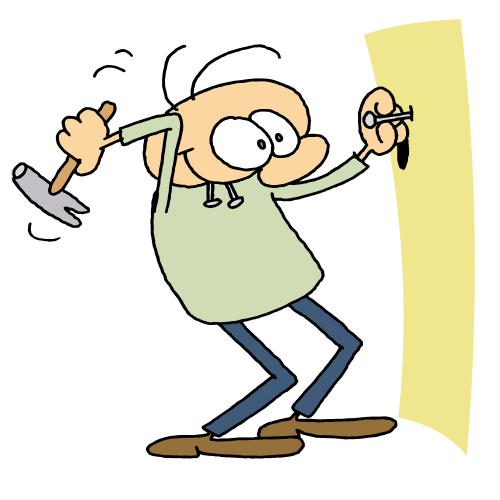
After another of his son’s verbal outbursts, the father gave him a bag of nails and instructed him that every time he lost his temper, the boy was to hammer a nail into the wooden fence behind their house. On the first day of this lesson, the little fellow had to drive nearly 40 nails into the fence. He was really angry that day.

Over the course of the next several weeks, the boy continued to obey his father and hammered a nail every time he lost his temper. Slowly he discovered he could control his temper. As he did, the number of nails he had to hammer decreased. The day arrived when the boy succeeded in not losing his temper a single time. Feeling triumphant, he couldn’t wait to tell his father the news.

The dad was pleased, but to reinforce the lesson he suggested for every succeeding day his son didn’t lose his temper, the boy should pull out one of the nails he had hammered into the fence.

Weeks went by until one day the boy announced all the nails had been removed. With a smile, the father gently took his son’s hand and led him to the fence. “You’ve done very well, my son,” the dad observed, “but look at the holes in the fence. The fence will never be the same.”

The father concluded the lesson: “When you say things in anger, they leave permanent scars just like these. And no matter how many times you say you’re sorry, or how often you apologize, the wounds remain. So be very careful with your words – and how you use them.”

“Stick and stones may break my bones, but names will never hurt me” was the adage I often heard as a child, but I’ve since learned it’s untrue. The pain we suffer from harmful words often endures long after physical pain ends. Parents that call their children “stupid” or make other disparaging comments may not realize it, but those words will probably echo in the minds of their offspring well into their adult years.

Be careful where you're
pounding those nails.
Earlier in my life if I became angry, I’d say whatever was on my mind. Kind of my speak-first, think-later approach to communicating. “Ready, fire, aim!” Then I realized, like the nails pounded into the fence, my words spoken in anger would leave wounds and scars that were slow to disappear, if ever. A Bible passage provided great wisdom: “In the abundance of words, transgression is unavoidable, but he who restrains his lips is wise” (Proverbs 10:19).

In fact, Proverbs has a lot to say about anger and words carelessly spoken. For instance, it states, “He who guards his lips guards his life, but he who speaks rashly will come to ruin” Proverbs 13:3). And Proverbs 29:11 advises, “A fool gives full vent to his anger, but a wise man keeps himself under control.”

Without question, this life presents much we can get angry about. Some of us are more prone toward anger than others. But “I can’t help it” doesn’t justify harmful, hurtful outbursts. As 1 Corinthians 10:13 declares, “No temptation has seized you except what is common to man. And God is faithful; he will not let you be tempted beyond what you can bear. But when you are tempted, he will also provide a way out so that you can stand up under it.”

Do I still get angry? Yup. Do I still want to blurt out thoughts in anger, giving people a piece of my mind I can’t afford to lose? Sadly, yes. But I’m much better than I used to be. I’ve learned “the devil made me do it” isn’t an excuse. And I’ve also realized what happens if you keep pounding those nails. When you pull them out, the evidence remains.